![[Case Study] Project Everest: The Deal That Died, Came Back, and Hid a $300K Error in the Books](https://cms.rapiddiligence.com/wp-content/uploads/2026/06/2.png)
A once dead deal got new life thanks to creative deal structuring under new SBA 7(a) rules. As the deal got underway, our due diligence revealed a major error that understated revenue by $300k, and opened up important questions for the buyer.
Here’s how we found it, what it meant for the deal, and what to do when bookkeeping threatens the future of an acquisition.
[The details of this deal have been anonymized to protect our client — we’re calling it Project Everest.]
A Creative Structure Brings New Life to a Dead Deal
We initially spoke with our client (the Buyer) in October 2023. The first-time buyer was under LOI for a healthcare service provider in Boston, but the deal fell apart once the seller had a change of heart and wanted to keep the family business instead of selling.
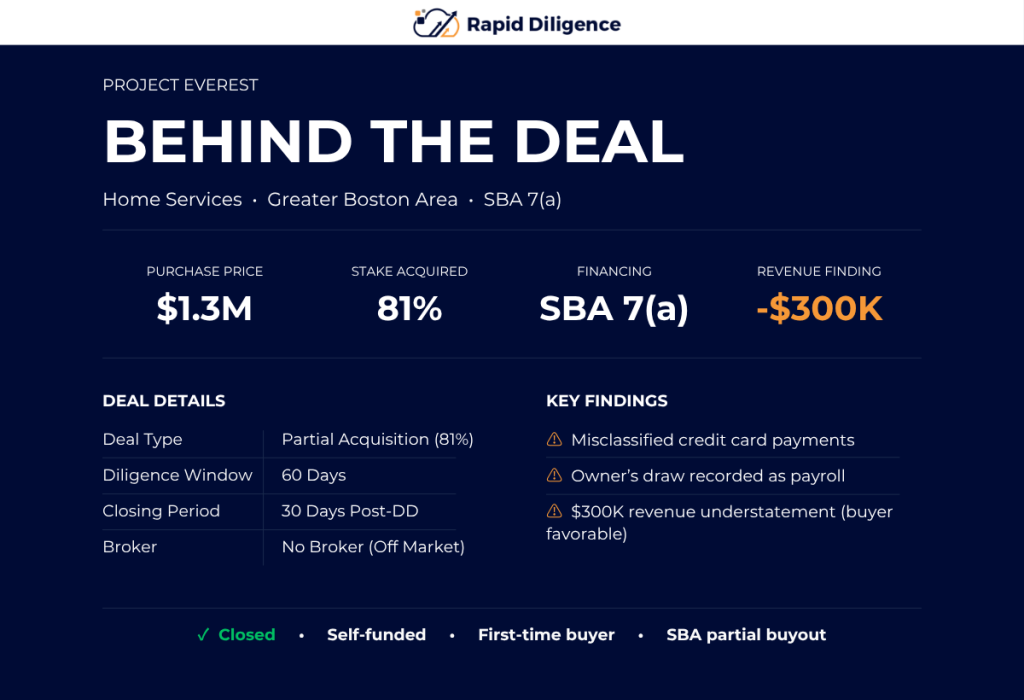
Rather than walking away, the Buyer got creative. Under the 2024 revised SBA 7a rules, partial acquisitions were now supported and it was no longer a requirement to acquire 100% of a business. So the Buyer proposed buying 81% of the business, allowing the seller to retain a small stake in their family business. Seeing that the buyer was trying to consider them in the deal structure, the seller reconsidered the sale and the deal moved forward.
It’s worth noting that while the suggested deal structure is what got the deal back on the rails, by closing the structure evolved and the buyer ultimately bought 100% of the business.
The LOI
In this deal, we had a fairly straightforward Letter of Intent (LOI):
- Roughly $1.3M for 81% of the business (initially structured as a partial acquisition; buyer ultimately acquired 100% of equity at closing)
- 60-day exclusive diligence period.
- Closing 30 days after the due diligence period ends.
- No inventory or retail location included as a part of the deal
This particular deal was a stock purchase due to being a home health business where the majority of revenue comes from reimbursements from insurance companies, Medicare, and Medicaid. Those reimbursement contracts take time to negotiate, and the rates are embedded in them. A stock deal was required so all existing contracts transferred directly to the buyer.
Whether a deal is structured as a stock purchase or asset purchase should be spelled out clearly in the LOI.
In a stock purchase, the buyer buys the company itself; the whole legal entity, including everything it owns and everything it owes. All contracts, liabilities, and obligations come along with it automatically.
In an asset purchase, the buyer picks and chooses what they’re buying, specific assets like equipment, customer lists, or contracts, and generally doesn’t inherit the company’s existing liabilities unless they agree to. The legal entity stays with the seller.
The practical way to think about it: in a stock purchase you’re buying the whole box, in an asset purchase you’re buying what’s inside the box.
For SMB deals, asset purchases are actually more common because buyers usually want the protection of not inheriting unknown liabilities. Stock purchases tend to come up when there’s something tied to the entity itself that can’t easily transfer — like the insurance reimbursement contracts in Project Everest, where the revenue relationships lived at the entity level and couldn’t just be reassigned.
A stock or asset purchase can be a tough negotiating point between parties, and being clear and specific in the LOI here will avoid tension later. In this case, the stock structure was driven by a specific operational need, not a negotiating preference, which made the decision straightforward.
Document Collection
Like most deals, our process kicks off with document collection. There was no broker involved in this deal so all data came directly from the sellers. Here’s everything we were provided:
- Prospectus
- Access to bookkeeping software for financial records
- P&L in spreadsheet format covering the past 36 months
- Bank and credit card statements for the last two years
- Annual tax returns
- W-2s
- 1099s
- Supplier/customer agreements for rate transferability
- Org chart detailing employee roles
- AR and AP aging reports
- Asset schedule
- Short term debt
- Liability schedule
A few of these are worth calling out specifically for this deal.
The asset schedule wasn’t particularly material here — home health is a service business, so there were no significant fixed assets.
In terms of the liability schedule, the business had several loans outstanding. In healthcare-related businesses, payroll is the primary expense and has to be met bi-weekly, while insurance reimbursements can take 30–60 days to come in after a service is provided. Bridging that timing difference well requires deliberate cash flow planning, and here, some of that planning hadn’t fully come together, so debt had been used to help cover it.
The AR and AP aging reports round out the picture by showing how current the receivables and payables are; how long money has been sitting uncollected, and what obligations are coming due. In a business where the reimbursement cycle is already slow by design, the aging profile of those receivables matters.
Seller Communication
As for the process of getting this data from the sellers, it was relatively straightforward overall. The sellers had access to their financial records and were responsive to requests.
That said, we did encounter some of the challenges that are pretty common in smaller, owner-operated organizations where bookkeeping isn’t the owner’s forte. In this case, we had to walk them through the process of sharing access to the bookkeeping software and bank transaction details.
You have to remember, for most sellers, this is the first time they’ve ever gone through a sale process. They’re not sure what to provide, how to provide it, or whether their data will stay confidential.
In those situations, we schedule a call with all stakeholders: buyer, seller, and broker if applicable. Doing so accomplishes two things. First, it gives us a chance to connect with the seller on a personal level. Second, the seller can open up about the issues they’re encountering so we can work collaboratively to resolve them.
There are always some hiccups during data collection. Effective communication and collaboration between parties is the key to resolving them.
The Diligence Process
The diligence process here followed our standard workflow: document review, financial analysis, and cross-referencing financial records against supporting third-party documents like bank statements, tax returns, W-2s, and 1099s.
The core of that process is the Quality of Earnings analysis — scrutinizing the company’s earnings, adjusting for one-time expenses or irregularities, and determining the appropriate add-backs to arrive at Seller Discretionary Earnings.
Throughout, we maintain open communication with all stakeholders to work through any discrepancies as they come up.
And just so no (unnecessary) red flags are raised; a discrepancy doesn’t automatically mean there’s an issue or fraud. Most of the time, the seller has a reasonable explanation that helps resolve anything misaligned that crops up.
What We Found in the Books
The whole point of working with a reputable QoE provider is to review financials with a fine tooth comb and discover any possible discrepancies that could impact the viability of the deal.
In the case of this business, some of the discrepancies within the books were common and easy to fix. Other bookkeeping issues, however, had a drastic impact on the reported earnings of the business.
Issue #1: Misclassified Credit Card Payments
There were some irregular expenses in the advertising expense account compared to historical periods. After digging in, we found that these were actually credit card payments, entries that should have been recorded to offset the liability, that were instead recorded to the advertising expense account erroneously.
Issue #2: Owner’s Draw Recorded as Payroll Expense
Owner’s draws (in addition to the owner’s W-2 wages) were included in the payroll expense account rather than the equity account on the balance sheet.
This mistake is pretty common. There’s an important distinction between owner’s pay, which includes payroll wages and bonuses, and an owner’s draw, which functions more like a dividend. The two don’t belong in the same bucket, and mixing them distorts the earnings picture if it isn’t caught and corrected.
Taken together, these two issues weren’t material to valuation, but they do reflect a recurring theme of bookkeeping practices that hadn’t been fully sorted out.
Issue #3: Revenue Understated by $300K
This was the biggest finding in the deal.
A historical repayment obligation with one of the insurance companies was being deducted directly from current-year revenue. The insurance company was reimbursing the net of the repayment obligation — but the correct treatment would have been to book that repayment obligation as a liability on the books and write it down as payments were deducted. Instead, the business was reducing its current-year revenue.
This error alone resulted in revenue being understated by $300K in FY 2023.
We brought all three issues to the seller, and they confirmed with their bookkeeper that these were errors that needed to be corrected to appropriately state the earnings of the business.
To be clear: this is not normal. We generally don’t see this many erroneous entries in a single engagement. But you’d be surprised what turns up. This is exactly why having an experienced CPA actually dig through the books matters.
The QoE Assessment and Good News for the Buyer
Our analysis revealed that while the EBITDA numbers provided by the seller were generally accurate, there were adjustments needed to correct the errors described above. The good news was that the first two issues were largely offsetting, so they didn’t materially impact EBITDA.
The repayment obligation issue was different. That $300K understatement of revenue was material, and because it was an understatement, it worked in the buyer’s favor. Had it gone the other direction, it could have potentially jeopardized the deal.
We also identified several non-recurring expenses that needed to be added back to provide a clearer picture of the company’s sustainable earnings: owner payroll above market rate, and auto and insurance expenses that were personal in nature.
One Item Flagged for Post-Close
The business had no receivables balance. They recorded revenue on a cash basis when payment was received from the insurance company. This isn’t necessarily a reason to walk away or renegotiate, but we raised it as something for the buyer to address after closing.
Not every finding like this is a deal-breaker. Some are simply worth knowing about before you’re running the business.
With three bookkeeping errors identified, corrected, and clearly documented in the report, there was nothing left standing between the buyer and the closing table.
How It Ended
Overall this deal went fairly smoothly on all fronts: getting access to the data we needed, the numbers aligning within the QoE, and getting across the finish line.
Here’s what the client wrote after we delivered the QoE:
“The folks at Rapid Diligence were extremely professional, communicative, and successful in the work they completed for my project. I would enthusiastically recommend them and their suite of services. My experience was delightful and the team is outstanding.”
The deal closed, with the buyer ultimately acquiring 100% of the equity. The partial structure that brought the seller back to the table was no longer needed by the time they reached closing. The lender did have some follow-up questions, specifically around the $300K understatement of revenue we uncovered due to the incorrect revenue recognition practices. Our report laid out the findings clearly and provided reference to supporting documentation, which made that conversation straightforward.
Key Takeaways
You’ve already seen which bookkeeping errors could tip the scales of a deal and the power of a creative deal structure on stuck deals. Here are a few other takeaways from this case study worth mentioning:
The deal isn’t done until it’s done: We’ve seen deals fall apart at the finish line for reasons that had nothing to do with the numbers. For example, sellers get cold feet, a family member gets sick, or a GM quits. The variables in an SMB acquisition are varied and often quite human, but you should always be ready to anticipate change while the deal is open.
A human-first approach moves deals forward: The buyer and seller in this deal found a creative path forward precisely because someone took the time to understand what the seller actually needed.
New SBA structures are worth knowing: The 2024 revised SBA 7(a) rules make partial buyout structures possible in ways they weren’t before. That opens up deal configurations that can work for buyers and sellers who might otherwise be stuck without proper funding.
Most issues aren’t fraud: In this deal, every finding had a reasonable explanation — messy books, poor accounting practices, miscategorized expenses. Those things still matter and need to be addressed, but they can be resolved professionally and collaboratively.
Final Thoughts
If you’re currently in the search phase, under LOI, or about to kick off diligence on a deal, we’d love to connect. We’ve worked on acquisitions across healthcare services, HVAC, accounting firms, eCommerce, med spas, light manufacturing, SaaS, and more. Our job is to make sure you walk into closing with a clear picture of what you’re buying.
Learn more at rapiddiligence.com or book an intro consultation with our team.