At Rapid Diligence, we’ve always cared a lot about operational organization. Honestly, probably more than most normal people should.
For years, we ran our deals through tools like Asana and other general project management software. And to be clear — those tools are good. They helped us support a lot of transactions and build strong internal processes early on.
But over time, we started realizing something:
We were spending more and more time building operational workarounds around software that fundamentally wasn’t designed for how we actually run due diligence.
The issue wasn’t that these platforms were “bad.” They just weren’t built for the level of customization, automation, auditability, and operational consistency we eventually needed internally.
And since Quality of Earnings (QoE) work is the core of what we do, that consistency matters to us. A lot.
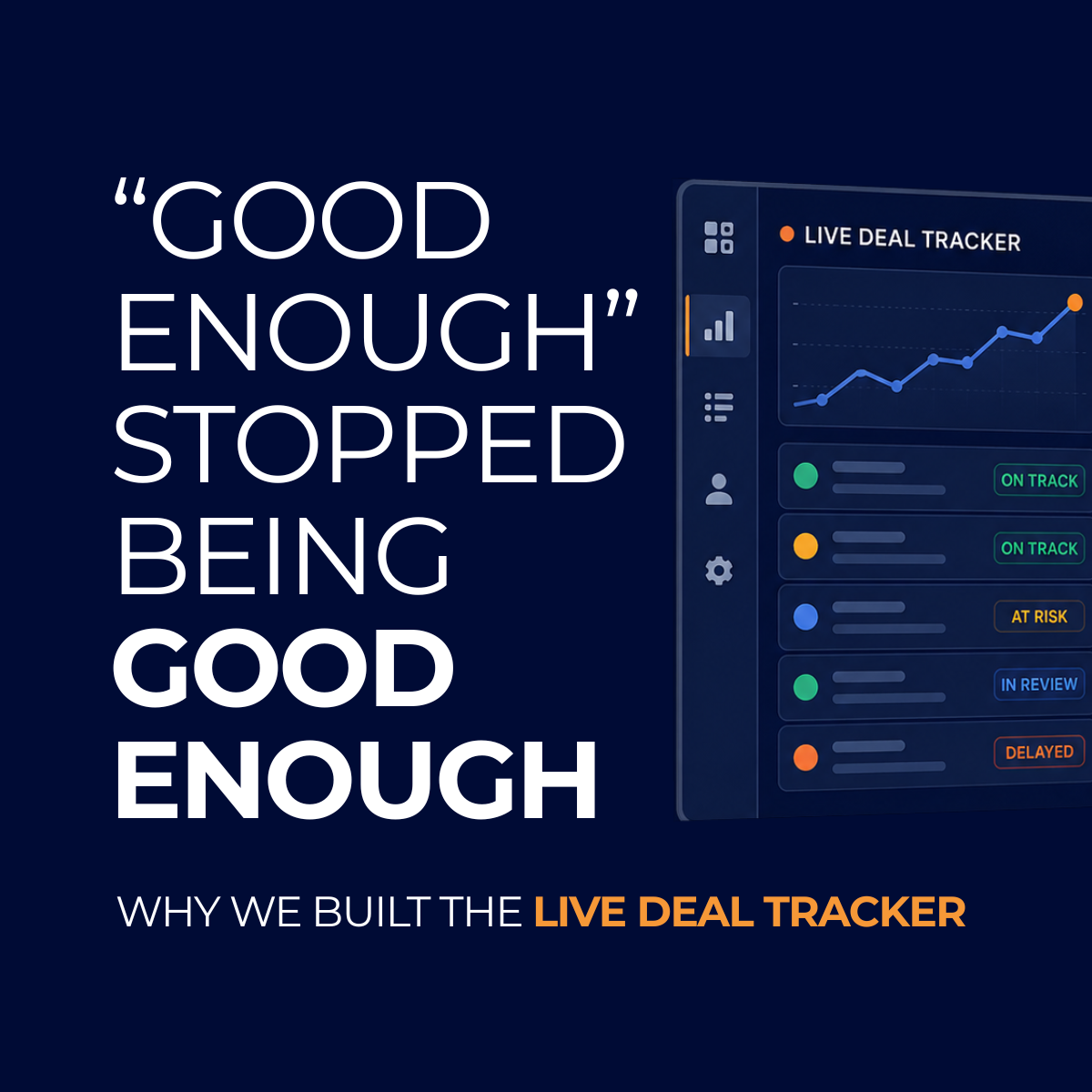
Eventually, “good enough” stopped being good enough.
So over the past few months, we built our own internal system: the Live Deal Tracker (LDT).
And truthfully, it has completely changed how we operate.
The Problem With Generic Software
One of the weird realities of financial due diligence work is that every deal has an enormous amount of moving pieces.
Emails. Data rooms. Internal notes. Client updates. Seller questions. Checklist progression. Document requests. File uploads. Slack discussions. Status changes. Reviewer comments.
Most firms handle this by spreading information across:
- inboxes
- spreadsheets
- Slack
- task managers
- shared drives
- institutional memory
And that often works just fine… until it doesn’t.
As we scaled, we realized we needed a true single source of truth for every deal we support.
Not just task management.
Actual operational infrastructure.
Building Around Our Process Instead of Adapting To Someone Else’s
A big part of the decision to build internally was realizing how custom our workflows had become.
Every diligence firm says they have a “process,” but in reality, many are still stitching together generic tools behind the scenes.
Our workflows are highly specific:
- custom deal ID systems
- stage-specific validation requirements
- internal quality control checkpoints
- automated onboarding flows
- custom communication policies
- centralized deal activity tracking
- review escalation systems
- standardized diligence checklists
Trying to force all of that into off-the-shelf software started creating friction.
We wanted the software to adapt to our process — not the other way around.
So we built it.
What The Live Deal Tracker Actually Does
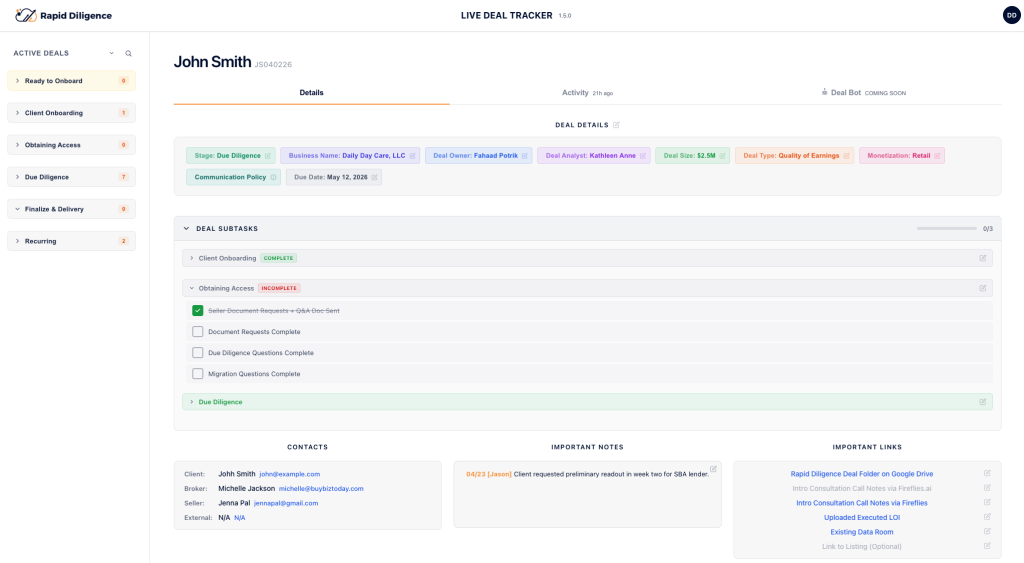
The Live Deal Tracker is our internal operating system for diligence engagements.
Every deal now has a centralized “pulse” that our team can see in real time.
That includes:
- deal status and progression
- all relevant contacts
- important notes
- data room links
- onboarding details
- internal assignments
- checklist progression
- uploads and document activity
- email activity
- status changes
- internal comments
- timeline history
- reviewer workflows
And because everything is centralized, nothing lives in someone’s head anymore.
The system comes before the people.
That was important to us.
Real-Time Activity Tracking
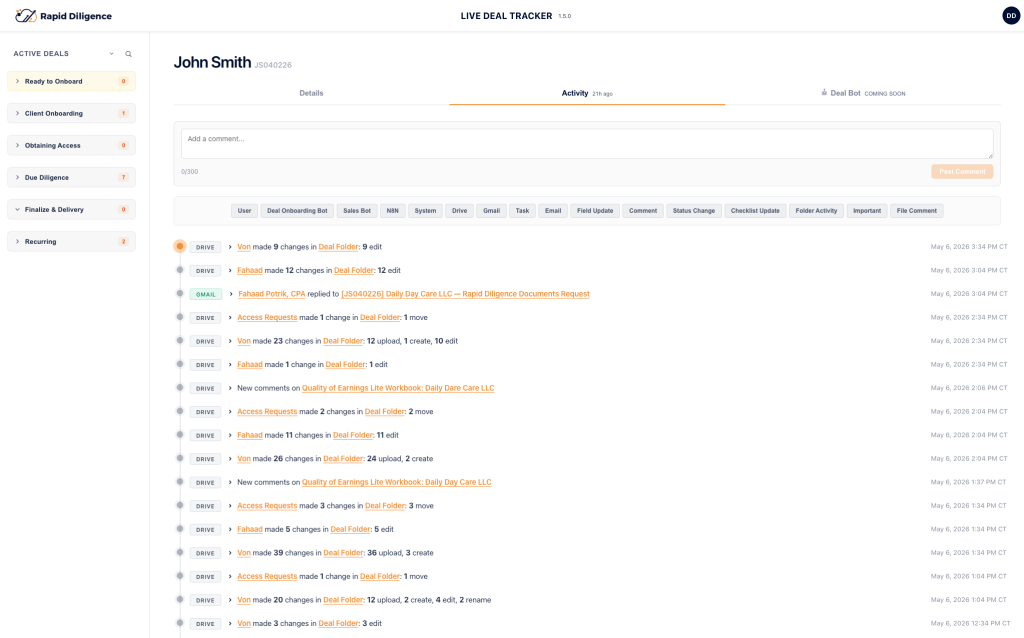
One of the most useful parts of the system has been the activity tracking.
Every meaningful action tied to a deal is automatically logged and timestamped:
- emails
- uploads
- checklist updates
- folder activity
- comments
- field changes
- status movements
- automation events
If a client uploads a file at 11:47 PM, it’s there.
If someone updates a communication policy, it’s logged.
If a deal moves into review, the system tracks it automatically.
If a deal has gone quiet for too long, our team gets notified automatically.
The goal wasn’t surveillance. The goal was reducing information decay and operational blind spots.
We never wanted situations where:
“Wait, did someone already send that?”
or
“Where was that uploaded again?”
or
“I thought somebody handled that.”
Now, the answer is always in the system.
Standardizing Quality As We Scale
One thing we care deeply about internally is consistency.
As we continue supporting more SMB acquisitions and QoE engagements, we wanted to ensure our quality standards scale with us.
Every stage inside the Live Deal Tracker has its own required checklist and validation process before a deal can progress forward.
That means onboarding, obtaining access, diligence, review, and final delivery all follow standardized operational workflows.
Not because we want things to feel rigid, but because consistency matters in diligence work.
Clients shouldn’t get a different experience depending on which analyst happens to touch the deal.
Automation > Administrative Overhead
A large part of the system today is actually automation rather than AI.
When a client completes onboarding, the Live Deal Tracker automatically:
- creates the underlying deal structure
- places the engagement into our onboarding queue
- alerts our internal team
- creates the data room structure
- creates internal Slack channels
- initializes workflows and permissions
- tracks onboarding progression
Processes that used to take meaningful manual coordination now happen in seconds.
That operational leverage matters because it allows our team to spend more time on actual Quality of Earnings and financial due diligence work instead of administrative overhead.
AI already exists in parts of the workflow today and will continue expanding over time, but the bigger immediate win honestly came from process automation and system design.
Why We Decided To Build This Internally
Another major factor was ownership.
By building internally, we fully own:
- the workflows
- the infrastructure
- the automations
- the data architecture
- the pace of iteration
If our team identifies a better way to operate, we can implement it immediately instead of waiting on another platform’s roadmap or trying to duct-tape together another workaround.
That flexibility has become incredibly valuable.
Further, modern tooling has made it possible for smaller, specialized firms to build infrastructure that historically only massive organizations could justify building.
We think that’s a pretty meaningful shift.
For those interested: the Live Deal Tracker itself is built using a custom React frontend, Firebase backend infrastructure, and N8N automations, but the bigger story honestly isn’t the tech stack.
It’s that we now fully own the operational layer behind how we support deals.
What This Means For Clients
Our clients won’t directly interact with the Live Deal Tracker itself, at least not yet.
Eventually, we do plan on exposing parts of the system through a client-facing portal with real-time engagement updates, but for now the platform is entirely internal.
That being said, clients will absolutely feel the downstream effects:
- faster onboarding
- more centralized communication
- better operational visibility
- cleaner internal handoffs
- more consistent execution
- improved scalability internally
- faster turnaround times
This wasn’t about building software for the sake of building software.
It was about creating operational infrastructure that supports the level of diligence work we want Rapid Diligence to be known for long term.
Final Thoughts
Look, we’re not pretending we discovered fire here.
This isn’t some revolutionary invention.
But it is a meaningful evolution in how we operate internally, and one that we believe will help us continue doing the best work possible for the clients we serve.
And truthfully, we’re pretty proud of it.
The Live Deal Tracker has been supporting live engagements throughout 2026 already, and it continues evolving constantly as our team uses it day-to-day.
At the end of the day, we believe great diligence work comes from great systems.
And we intend to keep building ours.
If you’re looking for a Quality of Earnings provider that takes operational execution seriously, we’d be happy to chat.
You can learn more about our services here or book an intro consultation with our team here.